


Forged vs Cast Wheels for the Toyota Hilux: What the Construction Difference Actually Means

Updated: Mar 24
Most wheel upgrade conversations for the Hilux start and end with looks. A set of wheels gets chosen because it fits the stance, matches the build, and lands within budget. That is not a wrong starting point, but it leaves out something that matters for a truck like this: how the wheel is actually made, and what that means when the truck is working.
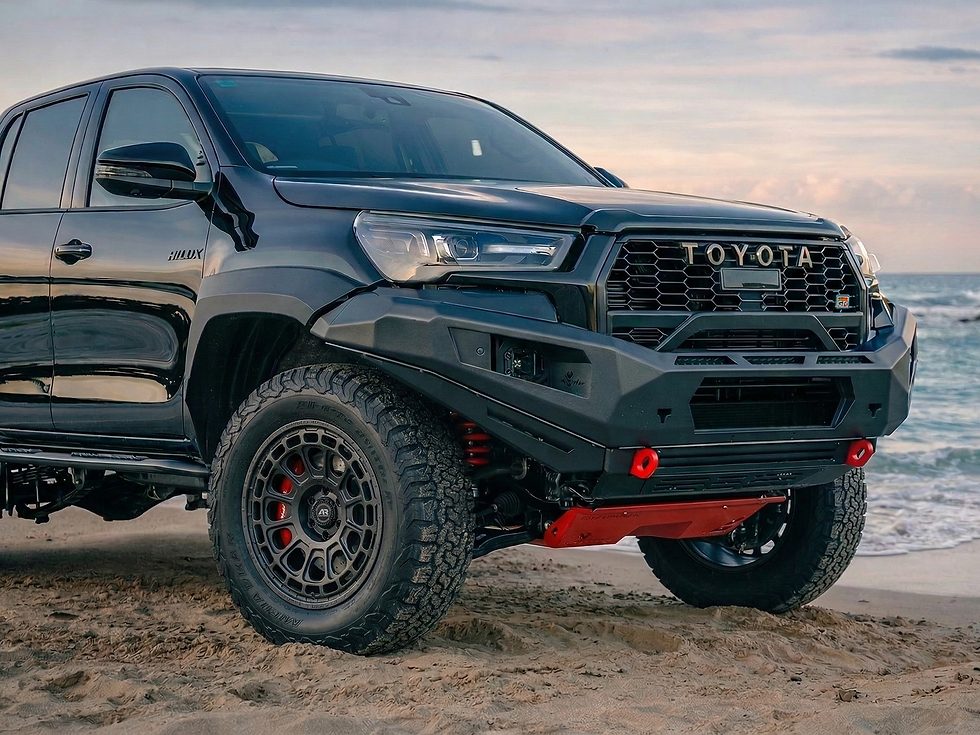
The Hilux is not a sports car. It carries loads. It navigates rough surfaces. It does this repeatedly, across heat and humidity, and in some cases across roads that put far more stress on structural components than the original design specification assumed. When a wheel is doing that kind of work, the difference between a forged and a cast construction is not theoretical.
This article explains what that difference is, how it affects the Hilux specifically, and how to think about it honestly without the usual upsell framing.
For fitment specifications — bolt pattern, offset, center bore — see our Toyota Hilux wheel fitment guide. This article focuses entirely on the engineering question.
Key Takeaways
Forged and cast wheels differ primarily in internal grain structure: forged aluminum is denser and more uniform, cast aluminum can contain microscopic voids from the cooling process.
Forged wheels are typically 20 to 30 percent lighter than cast equivalents of equivalent structural strength, which reduces unsprung mass and improves suspension response.
Under severe impact, forged wheels tend to bend rather than crack, which gives the driver more control in a failure situation.
For a Hilux used primarily in the city with light loads, a quality cast wheel is structurally adequate. The case for forged construction strengthens with payload, rough roads, and long-term sustained use.
Certifications like JWL, VIA, and IATF 16949 help distinguish between verified and self-declared quality claims.
Table of Contents
How Casting and Forging Produce Different Structures
The difference between a forged and cast wheel begins at the manufacturing stage and carries through the entire service life of the component.
A cast wheel is produced by pouring molten aluminum alloy into a mold and allowing it to cool and solidify. The process is efficient and cost-effective, which is why it is the dominant method for OEM and entry-level aftermarket wheels. The limitation is physical: as molten metal cools, it can develop microscopic air pockets within the material. These are not manufacturing defects in any obvious sense, they are a natural outcome of the solidification process. To compensate structurally, manufacturers add more material to the design, which adds weight.
A forged wheel starts from a solid billet of aluminum, typically aerospace-grade 6061-T6 alloy. That billet is heated and then pressed under thousands of tons of hydraulic pressure into its final form. The pressure compresses and realigns the grain structure of the metal, eliminating internal porosity entirely. The result is a component with denser, more uniform material throughout. Because the grain structure itself is stronger, less material is needed to achieve equivalent structural performance, which is where the weight reduction comes from.
The science behind this is covered in more depth in our article on the forging process and why structure matters. The short version: forging is not about premium branding. It produces a genuinely different material outcome.
What Those Structural Differences Mean in Practice
The two areas where the difference matters most for a working Hilux are weight and impact behavior.
Weight. Industry documentation consistently places forged wheels at 20 to 30 percent lighter than cast wheels of equivalent structural strength for a given size. For a truck, this directly affects unsprung mass, which is the total weight of all components not supported by the suspension: wheels, tires, brake assemblies, and axles. A lighter wheel allows the suspension to respond faster and more accurately to changes in the road surface. On rough terrain, this translates to better tire-to-ground contact, which has direct implications for braking, cornering stability, and driver control. Our article on unsprung weight and real-world performance covers this relationship in detail.
Impact behavior. Cast wheels, because they can contain micro-voids, are more susceptible to fracture under sudden severe impact. Forged wheels, with their denser and more uniform grain structure, tend to deform plastically, meaning they bend rather than crack when they encounter a force that exceeds their structural limit. For a Hilux navigating rural roads or exposed to sudden pothole impacts, a wheel that bends is recoverable; a wheel that fractures is not. This distinction is worth keeping in mind for trucks operating in remote areas.
Forged vs Cast: A Direct Comparison for Truck Use
Factor | Forged | Cast | Relevance for the Hilux |
Internal structure | Grain-aligned, no porosity | Random grain, potential micro-voids | Structural consistency under repeated load |
Weight | 20–30% lighter for equivalent strength | Heavier; needs more material | Lower unsprung mass; better suspension response |
Impact behavior | Tends to bend under severe force | Higher fracture risk under sudden impact | Recoverable failure mode matters on remote terrain |
Load capacity | Better suited for sustained and repeated loads | Adequate for standard on-road loads | Relevant for trucks regularly near payload limits |
Fatigue resistance | Higher; grain alignment resists stress accumulation | Lower; micro-voids are stress concentration points | Compounds over high-mileage working use |
Long-term cost | Lower replacement risk under sustained heavy use | Lower upfront cost; higher risk in demanding conditions | Total cost of ownership favors forged in heavy-use scenarios |
Certifications Worth Understanding
Wheel certifications are not all equivalent. Some are independently verified; others are self-declared by the manufacturer. Understanding the distinction helps when evaluating competing products that both appear to carry the same markings.
JWL (Japan Light Alloy Wheel Standard) requires wheels to pass defined rotary bending fatigue tests and impact tests. It is the most widely referenced standard across Southeast Asia. One important note: JWL compliance can be self-declared by the manufacturer. It establishes that the wheel has been tested to the JWL protocol, but the testing is not always independently witnessed.
VIA (Vehicle Inspection Association) adds a third-party verification layer on top of JWL. Where JWL allows self-declaration, VIA requires an accredited external body to conduct or witness the testing. A wheel carrying both JWL and VIA markings has been through that independent step. The distinction matters when two products make similar claims.
IATF 16949 is a quality management standard for automotive manufacturing facilities. It certifies the system producing the wheel, not the wheel itself. A facility holding this certification has been audited for process consistency, traceability, and quality controls across design, production, and delivery.
A full breakdown of what each standard actually requires is in our article on test standards: VIA, JWL, and IATF.
Considering an upgrade for your Hilux? The Aura Dakar Series is fully forged, FEA-tested, and certified to JWL, VIA, and IATF 16949 standards. Contact us on WhatsApp to discuss your specific setup.
Is a Forged Wheel Worth It for Your Hilux?
The honest answer is: it depends on how you actually use the truck.
For a Hilux used primarily in the city on well-maintained roads with light or no regular cargo load, a quality cast wheel is structurally adequate. The engineering advantages of forged construction do not disappear in urban use, but the practical difference is smaller in low-stress conditions.

The case for forged construction becomes more concrete the more these conditions apply: the truck regularly carries significant cargo or tows; it navigates rough provincial, agricultural, or unpaved roads with regularity; it operates in remote areas where a wheel failure is a serious logistical problem; or it has been lifted and is running wider offsets that place more lateral load on the bearings.
For trucks used across Malaysia's east coast plantation routes, the Philippines' flood-damaged provincial roads, or Thailand's agricultural interior, the stress loading on the wheel is meaningfully higher than most factory specifications assume. That context is covered in detail in our article on what Hilux owners in Malaysia, the Philippines, and Thailand should know before upgrading wheels.
The decision is straightforward when you are honest about use rather than aspirational about it.
Frequently Asked Questions
Is the weight saving from forged wheels actually noticeable on a Hilux?
Yes, though the degree depends on what you are comparing. The reduction in unsprung mass from a lighter wheel improves how quickly the suspension can respond to road surface changes. On smooth roads this is subtle. On rough or variable terrain, which is the more relevant scenario for a working Hilux, improved suspension response has a measurable effect on ride quality and vehicle control. Our article on the science of weight reduction covers the mechanics in detail.
Do forged wheels require different maintenance on a Hilux used off-road?
The core maintenance routine is the same: regular inspection for impact or surface damage, correct lug nut torque re-checked after rough terrain use, periodic rebalancing, and routine cleaning. Forged wheels are generally more resistant to surface cracking and fatigue failure under repeated stress, but attentive care after demanding use remains good practice regardless of construction method.
Are all forged wheels better than all cast wheels?
Not automatically. Construction method is one variable; design quality, alloy specification, heat treatment, and certification verification all matter independently. A well-engineered cast wheel from a reputable facility is a better choice than a poorly made forged wheel. The construction advantage only holds when the rest of the manufacturing process is also sound, which is why certification checking is worth doing.
What is FEA testing and why does it matter?
FEA stands for Finite Element Analysis, a computer simulation method that models how a structure behaves under various load and stress conditions. For a wheel, it allows engineers to identify stress concentration points, validate the design geometry, and confirm where material can be reduced without compromising structural integrity, before any physical prototypes are produced. An FEA-tested wheel has gone through that validated design simulation as part of its development process.
Can a forged wheel for the Hilux handle both daily road use and occasional off-road driving?
Yes. A wheel engineered for mixed use, which is how most Hilux owners across Southeast Asia actually operate their trucks, should handle both without any trade-off. The structural advantages of forged construction apply equally in daily road use and under the variable demands of off-road terrain. The key is confirming that the wheel's load rating is appropriate for your operating weight in both contexts.
Questions about construction, certification, or which Dakar model suits your Hilux? Reach us on WhatsApp or through our contact page. Browse the full Aura Dakar Series.
References
Aura Forged (2025). The Forging Process: Why Structure Matters More Than Looks. aura-forged.com/post/the-forging-process-why-structure-matters-more-than-looks
Aura Forged (2026). The Truth About Unsprung Weight and Real Performance. aura-forged.com/post/the-truth-about-unsprung-weight-and-real-performance-beyond-marketing-claims
Aura Forged (2025). The Truth About Test Standards: VIA, JWL, IATF. aura-forged.com/post/the-truth-about-test-standards-via-jwl-iatf
Revozport (2025). Forged vs Cast Wheels: The Ultimate Guide. revozport.com
AudioCityUSA. Cast vs Forged Wheels: Performance, Strength and Value. audiocityusa.com


Comments