


Forged Wheels for Tesla Model Y and Model 3 in the Philippines: A Complete Fitment Guide

Updated: Jul 31
Tesla entered the Philippines officially in late 2024, and by mid-2025, the Model Y had already crossed 1,800 units sold in the commercial vehicle segment alone, according to data from the Philippine Automotive Dealers Association. The Model 3 followed closely, and together these two cars have become among the most visible EVs on Metro Manila roads, from EDSA to C5 and beyond.
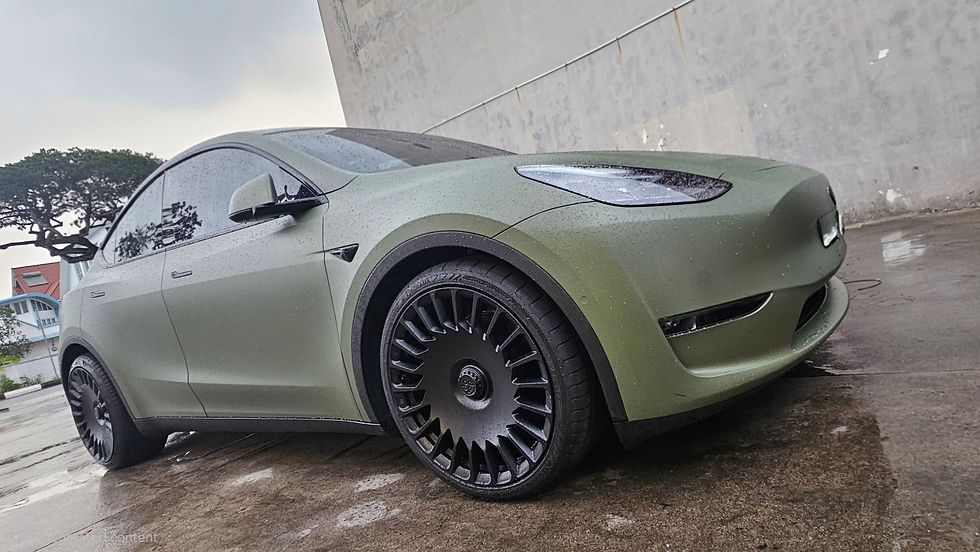
For many Tesla owners here, the stock wheels do the job well enough at first. But as you put more kilometers on your car, navigating the kinds of roads we actually have in the Philippines, a few things start to become clear: the OEM wheels are heavier than they need to be, aerodynamic efficiency matters more on an EV than on a petrol car, and upgrading to forged wheels is one of the more structurally meaningful changes you can make to either of these vehicles.

This guide walks through everything you need to know about upgrading to forged wheels on a Tesla Model Y or Model 3 in the Philippines: why the upgrade makes sense, what the correct fitment specifications are, and what to look for before committing to a set.
Key Takeaways
Tesla Model Y and Model 3 use a 5x114.3 PCD bolt pattern, which is a common forged wheel fitment across Southeast Asia.
Model Y fitment runs 19x9.5" ET33 or 20x9.5" ET33 in a square setup; Model 3 covers a wider range from 18x8.5" ET23 up to 20x9.5" ET29 depending on the build.
Forged wheels are structurally more appropriate for EV platforms because of higher curb weights and the nature of instant torque delivery.
Getting the offset wrong does not just affect appearance; it affects load distribution, bearing wear, and in some configurations, suspension clearance.
Not all aftermarket wheels carry the certifications (JWL, VIA, IATF 16949) needed to confirm they are safe under EV-specific load conditions.
Aura Forged wheels are engineered specifically with EV platform demands in mind, with fitment consultation available before any order is placed.
Table of Contents
Why Tesla Owners in the Philippines Are Looking at Forged Wheel Upgrades
Forged wheels offer structural and efficiency advantages over cast wheels that become especially relevant on EV platforms like the Tesla Model Y and Model 3.
The Tesla Model Y weighs approximately 1,979 kg to 2,003 kg depending on the variant. The Model 3 is lighter, around 1,611 kg to 1,830 kg. These are not light cars. When you factor in the instant torque delivery that every Tesla driver experiences the moment they press the accelerator, the stress placed on wheels at the contact patch is meaningfully higher than on a comparable petrol vehicle.
Cast wheels, which most OEM wheels and many aftermarket options use, are formed by pouring molten aluminum into a mold. The process leaves microscopic porosity throughout the metal. Forged wheels, by contrast, are shaped under high pressure from a solid billet of aluminum, which aligns the grain structure of the metal and eliminates that internal porosity. The result is a wheel that achieves higher strength at a lower weight, which has direct consequences for how your Tesla performs.
Lower rotational mass means the drivetrain works less to bring the wheel up to speed on each acceleration. On a petrol car, this difference is real but subtle. On an EV, where range is a function of energy efficiency and every kilogram of unsprung weight influences handling behavior and suspension response, the effect is more pronounced.
For Philippine Tesla owners, there is also the road context to consider. Metro Manila roads are not autobahns. Potholes, uneven expansion joints, speed bumps at irregular heights, and the occasional debris in rain conditions all place real stress on your wheels. A forged wheel's structural advantage is not just theoretical; it has practical relevance in how wheels absorb and distribute impact loads in daily driving here.

The Fitment Specifications You Need to Know
The correct fitment specification for any Tesla Model Y or Model 3 aftermarket wheel covers five variables: wheel diameter, width, offset (ET), bolt pattern (PCD), and center bore.
Getting these right matters because a wheel that sits at the wrong offset does not simply look different. It changes the scrub radius of the steering geometry, increases the load on wheel bearings over time, and in cases of significant deviation, can cause interference with brake calipers, suspension components, or the inner fender. On a Tesla, which uses a large diameter brake rotor and precise suspension geometry for its handling characteristics, fitment accuracy is not optional.
The bolt pattern on both the Model 3 and Model Y is 5x114.3. This is a common PCD shared across many Japanese and Korean performance vehicles, which means the aftermarket wheel selection is wide. Center bore on Tesla models is 64.1mm; when using aftermarket wheels with a larger center bore, hub-centric rings are required to ensure the wheel is centered on the hub rather than only on the wheel bolts.
Offset, expressed as ET followed by a number in millimeters, tells you how far the wheel's mounting face sits from the centerline of the wheel barrel. A higher ET value pushes the wheel face inward (tucking the wheel under the fender); a lower ET value pushes the wheel face outward (bringing the rim flush with or beyond the fender lip). For street driving in the Philippines, you generally want to stay within a measured range around the factory ET to avoid bearing strain and fender rubbing.
Model 3 Fitment: What the Data Says
The Tesla Model 3 (2017 onwards) supports a range of aftermarket wheel configurations, from efficiency-focused OEM-plus setups to more aggressive performance street fitments.
OEM-Plus Configurations (Efficiency and Daily Use)
These setups prioritize range, ride quality, and direct fitment without requiring any modifications.
Performance Street and Track Configurations
These fitments increase wheel width and are suited to owners who prioritize handling response and a more planted feel on Philippine expressways and track days.
Configuration | Wheel Size | Offset (ET) | Setup | Recommended Tyre Size | Notes |
Performance Square #1 | 18x9.5" | ET29 | Square | 265/40-18 | Direct fit. |
Performance Square #2 | 19x9.5" | ET29 | Square | 265/35-19 | Direct fit. 3mm spacer may be needed on Performance variant with select tyres. |
Performance Square #3 | 20x9.5" | ET29 | Square | 265/30-20 | Direct fit. |
Performance Square #4 | 19x11" | ET26 | Square | 295/30-19 | Centering rings required. Very aggressive track fitment; aftermarket suspension required. Some tyre poke will likely occur. |
For most Philippine road conditions, the 19x8.5" ET23 or 19x9.5" ET29 setups represent the most practical balance. The 20-inch performance fitments are best reserved for owners who spend meaningful time on smooth expressways or who use their Model 3 for track days.
Model Y Fitment: What the Data Says
The Tesla Model Y (2020 onwards) fitment data covers two square configurations in the OEM-plus category.
Both configurations use the same offset (ET33) and width (9.5"), which simplifies the decision to a diameter choice: 19-inch or 20-inch. The 19-inch setup retains more sidewall height, which cushions the wheel against road imperfections better. The 20-inch setup offers a slightly more planted visual and handling profile at the cost of tyre compliance over rough surfaces.
For Philippine conditions specifically, the 19x9.5" ET33 is a considered choice. It retains enough sidewall to absorb the minor road irregularities common in Metro Manila and provincial roads without compromising the visual upgrade or the structural improvement that comes from switching to a forged construction.
The Model Y's higher curb weight compared to the Model 3 makes the switch to forged wheels particularly relevant. A forged wheel that is 1.5 to 2 kg lighter per corner than the OEM cast equivalent represents a meaningful reduction in unsprung mass, and this has a measurable effect on how the Model Y's adaptive suspension responds to road inputs.
What to Look for in a Forged Wheel for Your Tesla
Not all forged wheels are the same, and the claims made by some suppliers in the Southeast Asia market do not always match the engineering behind the product.
Certifications Matter
For a forged wheel to be considered genuinely safe on a heavy EV platform, look for these certifications:
JWL (Japanese Light Alloy Wheel Standard): This Japanese standard sets minimum requirements for rotary bending fatigue strength, radial fatigue, and impact testing. A wheel carrying a JWL mark has been tested against defined structural criteria.
VIA (Vehicle Inspection Association): VIA testing is a third-party verification of JWL compliance. A JWL mark alone indicates self-declaration; JWL+VIA means an independent body has tested and confirmed the wheel meets those standards.
IATF 16949: This is a quality management certification for the manufacturing facility itself, confirming that the forging plant operates under controlled quality processes. It is not a wheel test result, but it is an important indicator of manufacturing discipline.
FEA (Finite Element Analysis): FEA is the computational modelling process used to verify structural integrity under simulated load conditions before a wheel goes into production. Ask whether the wheel design was FEA-validated.
All Aura Forged wheels carry IATF 16949, JWL, VIA, TÜV, and FEA validation. You can review the full Aura Forged range and engineering credentials here.
Load Rating
The Tesla Model Y has a Gross Vehicle Weight Rating (GVWR) in the 2,500 kg range, depending on configuration. Your wheels must be load-rated appropriately for the vehicle. A wheel specified for a lighter sports car and fitted to a Model Y is under-rated for the application, even if the bolt pattern matches.
Always confirm the load rating of any wheel you are considering against the vehicle's per-axle weight requirements.
A Note on Philippine Road Conditions and Why They Matter
The Philippines presents a specific set of road conditions that do not appear in most European or North American fitment guides, and these conditions are worth naming directly.
Speed bumps in the Philippines vary in height and gradient in ways that would not pass engineering review in many other markets. Many are steep enough that, at normal approach speeds, the wheel is subjected to a sharp vertical impact load. On a cast wheel, this is where subsurface porosity becomes a failure point over time. On a forged wheel with consistent grain structure, the same impact distributes across the material differently.
Flooding is also a consideration. Driving through standing water obscures what is beneath the surface. Wheels absorb lateral and vertical loads in these conditions without any feedback to the driver until damage has occurred. The structural consistency of a forged wheel provides a wider safety margin in these scenarios compared to cast alternatives.
None of this is to say that OEM or cast wheels will fail immediately. The point is that the structural advantage of forging, which is measurable and documented in engineering literature, becomes more relevant in the Philippine context than it would be on a well-maintained European motorway.
If you are researching the broader case for why forged wheels matter on EV platforms, this existing article on forged wheels for BYD and Tesla EVs covers the engineering logic in more detail.
Ready to Start Your Fitment Inquiry? Let's Confirm Your Specification First.
Knowing your model, variant, and preferred wheel diameter is the starting point. From there, offset, width, tyre sizing, and finish selection follow naturally. Aura Forged provides direct fitment consultation before any order is placed; there is no obligation and no sales pressure involved.
Submit a fitment request here or message us on WhatsApp and one of our team will respond within one business day.
Frequently Asked Questions
What is the bolt pattern for Tesla Model Y and Model 3?
Both the Tesla Model Y and Model 3 use a 5x114.3 PCD bolt pattern. The center bore is 64.1mm. Hub-centric rings are required if your aftermarket wheels have a larger bore diameter.
What size forged wheels fit the Tesla Model Y in the Philippines?
The Tesla Model Y fits 19x9.5" ET33 or 20x9.5" ET33 in a direct-fit square configuration. Both sizes use 255/45-19 or 255/40-20 tyres respectively, with 265-width tyres also fitting directly.
What is the correct offset for Tesla Model 3 aftermarket wheels?
For OEM-plus daily use, the Model 3 uses ET23 for 18x8.5" and 19x8.5" setups. Performance configurations use ET29 across 18", 19", and 20" widths. ET34 is also used on the 19x9" centering ring fitment. Confirm your variant before ordering.
Do forged wheels improve Tesla range?
Forged wheels can contribute to improved efficiency through two factors: lower rotational mass reduces the energy needed to accelerate the wheel, and aerodynamically optimised designs reduce drag at the wheel face. The aggregate effect on range varies by design and driving conditions.
Are forged wheels safe for Tesla on Philippine roads?
Forged wheels are structurally better suited to the demands of Philippine roads than cast alternatives. Their consistent grain structure handles impact loads from speed bumps and potholes with a wider safety margin. Confirm the wheel carries JWL, VIA, and appropriate load ratings for your Tesla variant.
Ready to Confirm Your Fitment?
Getting the right forged wheel for your Tesla Model Y or Model 3 in the Philippines starts with a conversation, not a catalogue. The correct width, offset, and diameter depend on your specific variant, your tyre preferences, and how you use the car day to day.
I have been working in automotive brand management across Southeast Asia for over three decades. When I built Aura Forged, the intent was straightforward: to make properly engineered forged wheels available to owners who understand the difference between a product and a compromise. If you own a Tesla in the Philippines and you are thinking seriously about this upgrade, let us talk through the specifications with you before you make any decisions.
Submit your fitment request or reach us directly on WhatsApp.
You can also explore the full Aura Forged wheel range, including the Aero-Forged Series designed specifically for EV platforms, and the Precision Series for performance-oriented builds.
About the Author
Brinal Chua is the founder of Aura Forged and brings over 30 years of automotive brand management experience across the ASEAN region. His work has spanned some of the most recognized names in the industry, and Aura Forged represents his conviction that precision-engineered wheels should not require paying for brand elitism. Learn more at brinal.co.
References
Rappler: Tesla Philippines Opens Experience Center, November 2024 - Source for Tesla's official entry into the Philippines with Model Y and Model 3 pricing and delivery timeline.
The Manila Times: How 2025 Became the Breakout Year for EVs in the Philippines - Source for Tesla Model Y and Model 3 pricing in Philippine market context.
Zigwheels Philippines: Tesla PH Oct. 2025 YTD Sales - Source for Tesla Philippines sales data, January to October 2025.


Comments