


What Most People Don't Know About Wheel Aerodynamics: The Hidden Performance Factor

Most drivers obsess over horsepower, torque figures, and tire compounds. They'll spend hours debating brake pad materials or suspension geometry. But mention wheel aerodynamics, and you'll get blank stares.

That's unfortunate, because your wheels are spinning through air at highway speeds, creating drag that costs you range, efficiency, and performance. After decades working with performance vehicles across ASEAN markets, I've watched this overlooked factor become increasingly critical, especially as EVs reshape what matters in automotive engineering.
Let me share what the data actually shows.
Key Takeaways
Wheel aerodynamics can affect EV range by 3-8% depending on design and driving conditions
Spoke count, shape, and surface finish create measurable turbulence impacting efficiency
Open spoke designs improve brake cooling but increase drag requiring careful balance
ASEAN's tropical climate makes brake cooling aerodynamics critical for performance and safety
Modern CFD analysis reveals patterns invisible to the naked eye guiding optimal spoke geometry
Table of Contents
Why Wheel Aerodynamics Actually Matter
Your wheels spin in open air, exposed to direct airflow at whatever speed you're traveling. Unlike body panels or underbody components, wheels add the complexity of rotation. Air doesn't just flow around them; it interacts with spinning surfaces creating unique turbulence patterns.
At 100 km/h, common on ASEAN highways from Singapore's expressways to Philippine tollways, your wheels rotate approximately 13 times per second. Each rotation churns air, creating drag that your engine or electric motors must overcome.
For traditional combustion vehicles, this represents a small but measurable fuel economy impact. For EVs like the Tesla Model 3 or BMW iX, where every watt matters for maximizing range, wheel aerodynamics become significantly more important.
Recent computational fluid dynamics (CFD) analysis we conducted on the Aura Precision Series revealed something fascinating: spoke design changes of just 5-8mm in certain dimensions altered drag coefficients by measurable amounts. Not enormous differences, but enough to impact real-world driving efficiency.
Consider what this means for a Tesla Model Y in typical ASEAN urban-to-highway driving. A 5% efficiency improvement translates to roughly 20-25km of additional range per charge. Over a year of driving, that's thousands of kilometers.
The Physics Behind Rotating Turbulence
When wheels rotate, they create two types of aerodynamic effects: drag and turbulence.
Drag comes from air resistance against the wheel face and spokes. As the wheel spins, it must push air out of its path. The shape and surface area of spokes determine how efficiently this happens.
Turbulence occurs when airflow separates from spoke surfaces, creating chaotic air patterns that require energy to maintain. More turbulence means more energy lost, which translates directly to reduced efficiency.
Here's where it gets interesting: turbulence patterns change based on spoke count, spoke profile, and surface finish.
Spoke Configuration | Aerodynamic Efficiency | Brake Cooling | Typical Application |
5-spoke (wide profile) | Moderate drag | Excellent cooling | Performance, sports cars |
7-10 spoke (slim profile) | Lower drag | Good cooling | Balanced performance |
Multi-spoke (12+) | Higher drag | Moderate cooling | Luxury, comfort focus |
Covered/aero disc | Lowest drag | Poor cooling | EVs, efficiency focus |
The Aura Iconic Series reimagines classic motorsport designs with modern aerodynamic understanding. Those heritage five-spoke patterns weren't just aesthetic choices; they represented optimal balance between structural strength, brake cooling, and aerodynamic efficiency given the materials and analysis tools available decades ago.
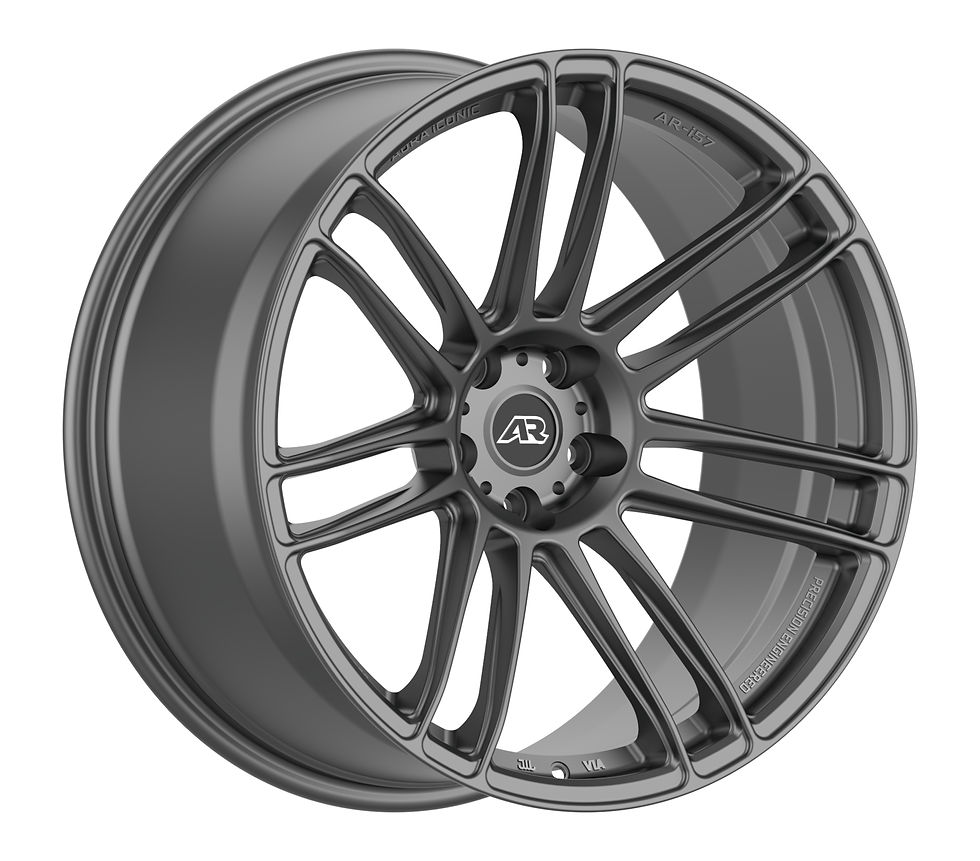
Today's CFD modeling reveals opportunities those original designers couldn't see. Subtle spoke shaping, carefully calculated spoke width tapering, and strategic surface finish selection reduce turbulence without sacrificing the visual character that made those designs legendary.
How Spoke Design Affects Efficiency and Cooling
This is where engineering trade-offs become unavoidable. You cannot optimize purely for aerodynamics without consequences.
Fewer, wider spokes: These create larger openings for brake cooling airflow. In ASEAN's tropical climate, this matters. Track days in Sepang or Sentul reach extreme temperatures. Even spirited highway driving generates significant brake heat.
The downside? More surface area perpendicular to airflow means higher drag. Each wide spoke acts like a small sail, creating resistance as it rotates through air.
More, thinner spokes: These reduce individual spoke drag but increase overall surface area and turbulence. The space between spokes becomes crucial. Too close, and they create turbulent wake patterns that actually increase total drag compared to fewer wider spokes.
Spoke profile shape: Rounded edges reduce turbulence compared to sharp edges. Airflow separates more gradually, maintaining laminar flow patterns longer. This is why performance-focused designs often feature subtly curved spoke profiles rather than simple flat surfaces.
When we worked with the Mercedes-AMG and BMW performance builds, brake cooling took priority over maximum aerodynamic efficiency. These vehicles generate substantial heat under performance driving, especially with powerful brake systems. Spoke designs needed sufficient opening area for adequate cooling airflow.
For EVs, the calculation shifts. Regenerative braking reduces traditional brake usage significantly. A Tesla Model 3 Performance might use friction brakes only 20-30% of the time in typical driving. This allows more aerodynamically efficient designs without compromising cooling.
Real-World Impact on EVs and Performance Cars
Let's quantify what this actually means for vehicles common in Southeast Asian markets.
For EVs: A properly optimized aerodynamic wheel design can improve highway efficiency by 3-5% compared to a purely aesthetic design that ignores airflow. For a Tesla Model Y Long Range with 525km WLTP range, that's 15-26km of additional driving per charge.
Over a year covering 20,000km, you're looking at measurable energy savings. In Singapore's electricity rates, this translates to real money. More importantly for regional driving, it extends the viable range between charging stations.
The Bentley Continental GT and Tesla builds we documented showed these principles in practice. For the Tesla, we selected spoke configurations balancing the owner's aesthetic preferences with aerodynamic efficiency appropriate for their highway-heavy driving patterns.
For performance sports cars: Aerodynamics matter differently here. A Porsche Cayman or BMW M4 generates significant brake heat during spirited driving. Wheel designs must prioritize cooling airflow, even if this compromises ultimate aerodynamic efficiency.
However, spoke shaping still matters. Subtle profile optimization can reduce drag by 2-3% without sacrificing cooling performance. On a track, this might save one-tenth of a second per lap. Not decisive, but measurable.
Surface finish considerations: Glossy finishes create slightly smoother airflow than heavily textured surfaces. The difference is small, typically 1-2% in controlled testing, but it exists. This is why many aerodynamically-focused wheels feature polished or smooth painted finishes rather than heavily textured coatings.
Ready to optimize wheel selection for your specific driving patterns? Contact us via WhatsApp and we'll discuss designs that balance performance, efficiency, and aesthetics for your vehicle.
Balancing Aesthetics with Aerodynamic Function
Here's the challenge: most drivers choose wheels primarily for appearance. Aerodynamics ranks somewhere below size, finish, and price in typical decision-making.
I understand this completely. Your wheels are among the most visible components on your vehicle. They define stance, communicate style, and express personality. Purely functional designs that ignore aesthetics won't satisfy most enthusiasts.
The solution isn't choosing between looks and function. It's finding designs that achieve both.
Modern engineering enables this balance:
When we design for the Aura Precision Series, we start with performance requirements: load ratings, impact resistance, weight targets. Then we add aerodynamic optimization through CFD analysis. Finally, we refine visual character to create designs that look purposeful and refined.
This process doesn't compromise. It integrates requirements from the start.
The Iconic Series demonstrates this approach beautifully. We took designs that defined generations of motorsport, then asked: how would these be optimized if designed today, with modern analysis tools and materials?
The answer involved subtle changes invisible in static photos but measurable in wind tunnel testing. Spoke profiles gained slight curvature. Surface transitions smoothed. Dimensions adjusted by millimeters based on CFD data.
The visual character remains faithful to heritage. The aerodynamic performance reflects 21st-century engineering.
Practical recommendations for ASEAN drivers:
If you drive primarily in urban conditions with frequent stops, brake cooling matters more than ultimate aerodynamic efficiency. Choose designs with adequate spoke openings.
If you cover long highway distances, especially in EVs, aerodynamic optimization becomes more valuable. Consider spoke count and profile more carefully.
For mixed driving, which describes most ASEAN usage patterns, balanced designs work best. This is why we focus our engineering on real-world versatility rather than extreme optimization for single scenarios.
Track enthusiasts need maximum brake cooling. Aerodynamic efficiency becomes secondary to thermal management. Wide-spoke designs with generous openings prevent brake fade during extended sessions.
FAQs
Do wheel aerodynamics really affect fuel economy in normal cars? Yes, but modestly. Expect 1-2% differences between well-designed and poorly-designed wheels in typical combustion vehicles. For EVs, the impact increases to 3-8% depending on design and driving patterns.
How much does spoke count matter for efficiency? Less than spoke profile and surface area. A well-shaped eight-spoke design can be more efficient than a poorly-shaped five-spoke design. Total surface area and airflow patterns matter more than simple spoke count.
Are covered aero wheels best for EVs? They're most aerodynamically efficient but compromise brake cooling. For EVs with strong regenerative braking and modest brake usage, they work well. For performance driving, partial coverage or optimized spoke designs balance both requirements.
Does wheel finish actually affect aerodynamics? Slightly. Smooth finishes create marginally better airflow than heavily textured surfaces, typically 1-2% difference. For most drivers, this is less important than durability and appearance preferences.
How can I tell if a wheel design is aerodynamically efficient? Look for smooth spoke profiles, gradual transitions, and absence of sharp edges. Manufacturers focused on efficiency typically mention CFD analysis or aerodynamic testing in their engineering documentation.
Engineering That Considers Everything
Wheel selection involves more factors than most realize. Strength, weight, aesthetics, durability, cost—all matter. But aerodynamics deserve consideration too, especially as vehicles evolve toward electrification where efficiency becomes paramount.
At Aura Forged, we engineer with this complete picture in mind. Our 6061-T6 aluminum construction creates the structural foundation. FEA analysis optimizes strength-to-weight ratios. CFD modeling refines aerodynamic performance. And throughout, we maintain the visual character that makes wheels emotionally satisfying, not just functionally efficient.
This comprehensive approach defines modern wheel engineering. It's why the Precision Series performs well in wind tunnel testing while looking purposeful and refined. It's why the Iconic Series honors motorsport heritage while incorporating aerodynamic improvements those original designers would have made given today's analysis capabilities.
Ready to discuss wheel selection for your specific vehicle and driving patterns? Send us your car details and usage requirements. We'll recommend designs that optimize the complete performance picture, including the aerodynamic factors most drivers never consider but that affect every kilometer you drive.
References
"Aerodynamic Impact of Wheel Design on Vehicle Efficiency." Society of Automotive Engineers (SAE) Technical Paper 2023-01-0647, https://www.sae.org/publications/technical-papers
Wickern, Gerhard, et al. "Rotating Wheels - Their Impact on Wind Tunnel Test Techniques and on Vehicle Drag Results." SAE International Journal of Passenger Cars, 2006.


Comments